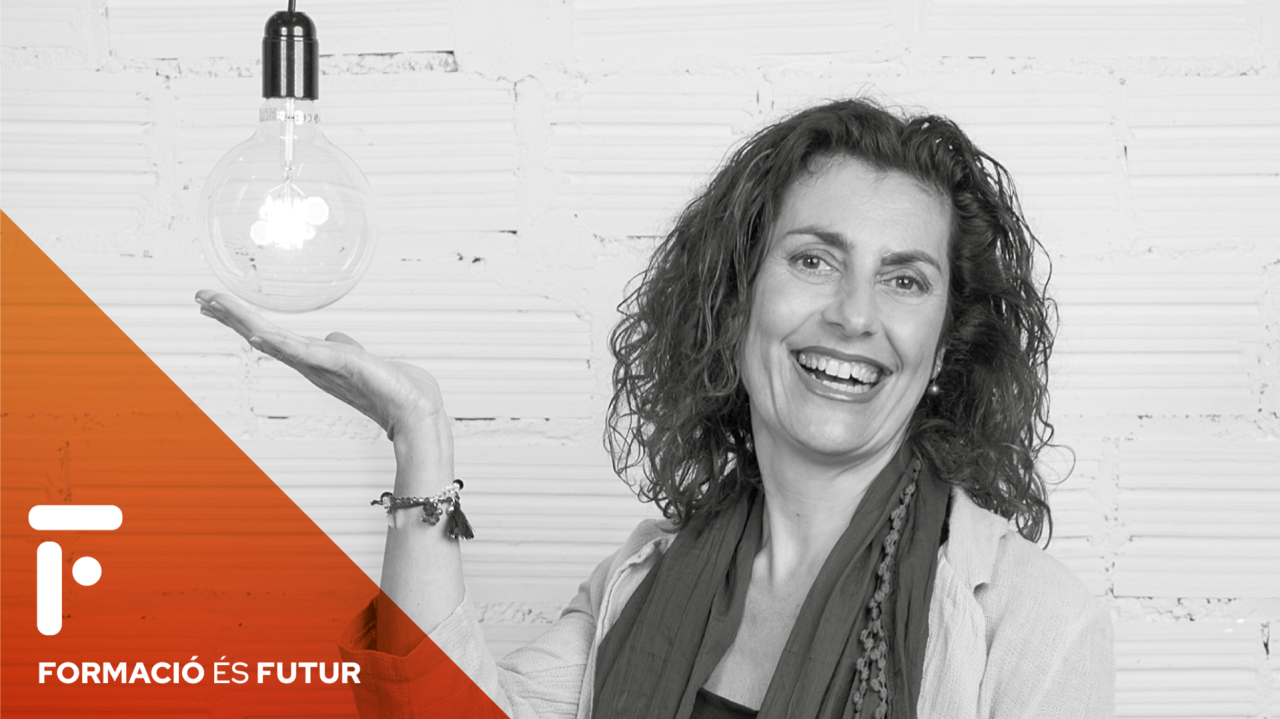

Next, the interview conducted by the Chamber with Maria Muñoz Roca, with a regular collaborator in Continuous Training
1. Communication is a fundamental element both in the professional and personal sphere. Who is the most important in making a difference in leadership and interpersonal relationships?
Communication is an eine that is present in all of our daily, professional and personal activities. The key to the success of a person is to relate the problem in how we communicate with that person: with parlem, with support, with mirem, who paraules escollim, with empathy, with demonstration of our respect for the six opinions...
In leadership, the leader must prioritize communication with his team and the goal of contact in order to help him and add value.
When the leader takes care of interpersonal relationships with his team, he is taking care of people. To take care of people we have to take care of communication.
- Sense communication, no leadership.
- Sense communication, no hi ha equip.
- Sense communication, no results.
A very important common ingredient of leadership and communication is Creativity. A creative communication is a conscious, personalized and unique communication. Creative leadership is leadership that focuses on the individual needs of each person and, in turn, is leadership that builds teams.
2. As an expert in social skills, who would you give advice to face difficult conversations in an effective and assertive way?
Facing a difficult conversation is always a challenge. We need to keep our rational and emotional communication balanced with the objective of arriving at a satisfactory solution for all parts.
Effectiveness and assertiveness always go together. Effective communication involves respecting the other person and meeting their needs. This is about proximity, about connecting with the other person and knowing how to be able to form a “team”.
Assertive communication, moreover, also implies respecting each other, daring to demand, having self-confidence, knowing how to express our emotions and faith in self-connection and well-being.
3. Emotional intelligence plays a key role in communication. How can we develop this competition to improve our daily interactions?
Emotional intelligence is the great pending subject. Molts copenem amb les experiències de la vida. Fortunately, in schools and universities I began to talk about emotional intelligence and began to practice it in real or simulated situations.
A good way to develop it is to do an analysis of our strongholds and our world's areas when it comes to intra-personal (amb un mateix) and interpersonal relationships. Ens coneixem bé? Do we know how to enhance our strengths? Will we dedicate effort and perseverance to million?
We have a diagnosis and the responsibility to take action. Little things, little decisions can give us great results. Create new habits depending on the will of each person. When will you start?
4. Companies may avoid conflicts. What strategies do you recommend to manage them constructively through communication?
It is always a pleasure to tell the members that the best strategy is to anticipate the conflict and prevent it from arriving.
I moltes vegades, això està en les notres mans: observant el que està passant al nosstre voltant, inquirant, investigant, tenint que conversa pendent, escortant...
When the conflict is already here, allow me to give 3 recommendations:
- Objectively raise the conflict: differentiate the one that I thought had happened from the one that had actually happened. Collect real information, sense jutjar.
- Create a climate of trust between the parties involved. I speak of communicating exquisitely from the first minute: with positive paraules, with an adequate facial expression and with a professional appearance.
- Being open to changing opinions: managing our ego, which sovint ens poses an antifaç davant dels ulls and does not allow us to see more.
5. Who plays a role in non-verbal communication in difficult conversations and in building trusting relationships?
Neuroscience and neurolinguistic programming are demonstrating, day by day, how important non-verbal communication is.
They have always taught us to structure our missatge, the one who dies in our paraules. It is clear that this is very important. It's the first step. It is the contingut that volem transmits. It is the most rational part of the missatge.
I as a woman arrive at this missatge to the interlocutor? How do I influence the interlocutor? How do we potentiate the impact of our ideas? The answer is both non-verbal language. It is the most emotional part of communication, the truly “transformative” part, the “human” part of communication. We must ensure that we generate trust and commitment to non-verbal language
A look of complicity, appropriating the interlocutor, showing understanding with a gesture of our cap, emphasizing the first paragraphs with a rhetorical question, creating a climate of trust with a calm and compassed view, escorting without interrupting, opening our cap to the other person allows the dialogue... Language does not Verbal is magical, allowing us to be unique in our communication and personalize each message.
6. Finally, who will advise those people who want to improve their ability to communicate in complicated situations?
Mainly, preparation, resolution and creativity. Each situation is different and each resolution is also different.
Let's start in the world of communication with many questions. It was difficult for people with different ideas, cultures, experiences and education without reaching a single satisfactory agreement for everyone.
One day I will discover the key to success, the essence of Communication. It is tracted from:
- Gaudir how to communicate
- Gaudir escorts people
- Gaudir assisting them
- Gaudir learns from them
- Gaudir looking for solutions
- …
- Gaudir of this great repte that is Communication